


Why Does My Baby Always Move to the Edge of Crib?


Normal sleep movement and developing motor skills can carry a baby toward the edge, corner, side, or top of the crib, and this is common at every age.
Position alone usually matters less than three things: whether the sleep space is firm, flat, level, bare, and intended for infant sleep; whether your baby can roll in both directions; and whether your baby is trapped, obstructed, injured, or in distress.
If those three things check out, the exact spot your baby ends up in is rarely a concern on its own.
When can babies move to the crib?
A crib that meets current safety standards can be used safely from birth, so there's no set age a baby needs to reach before moving into one.
The real question is usually about moving out of a bassinet or a smaller sleep space, and that depends on the specific product, not a fixed age.
Every bassinet has its own manufacturer limits on weight, size, rolling, pushing up, sitting, or general mobility, and those limits vary by brand and model. Check your product's instructions directly rather than relying on a general age rule.
Before using any crib, confirm it's fully assembled according to the manufacturer's instructions, check the mattress is set at an appropriate height for your baby's mobility, and make sure the sleep surface stays level and firm.
Is it good for babies to sleep in the crib?
The safety benefit comes from a compliant sleep environment and consistent safe-sleep practices, not from the word "crib" by itself. A crib is one good way to provide that environment, but it's the practices inside it that matter.
What makes a sleep space safe
According to NIH's Safe to Sleep campaign and the Consumer Product Safety Commission, a safe sleep space is:
- firm
- flat
- level
- bare except for a fitted sheet
- designed and approved for infant sleep
- assembled and used within the manufacturer's limits
The CPSC's crib safety guidance specifies no more than 2⅜ inches between crib slats, along with a firm, tight-fitting mattress and no missing, loose, broken, or improperly installed hardware. Use the mattress support at the height specified by the manufacturer for your baby's mobility, and follow the crib's assembly, mattress-size, and usage instructions.
For the full safe-sleep discussion, including room-sharing and additional environment guidance, see our SIDS and safe sleep guide.
Why does my baby always move to the edge of the crib?
Several well-documented things about how babies sleep and move explain most of this, rather than any single deliberate reason for choosing the edge.
Active sleep and immature motor control
According to the American Academy of Pediatrics, newborn sleep is divided about equally between REM, or active sleep, and non-REM sleep.
During active sleep, babies may twitch or jerk their arms and legs. Because their motor control is still developing, repeated small movements can gradually carry them toward the edge, corner, or top of the crib.
Rolling, pivoting, and rotating
As babies develop the strength and coordination to roll, push up, and eventually crawl, rotating 90 degrees or a full 180 degrees over the course of a sleep session is common.
A baby placed at one end of the crib can pivot, scoot, or roll their way to a completely different position or corner by the time they wake, without ever fully waking up in between.
The Moro reflex
In the first few months, involuntary movement from the Moro, or startle, reflex can shift a baby's position during sleep.
NIH's Safe to Sleep campaign notes that babies may begin rolling as early as 2 months, while MedlinePlus says the Moro reflex normally fades after about 3 or 4 months.
Timing varies, so reflexive movement and early rolling can overlap.
How this can look by age
Development varies from baby to baby. Around 2 months, much of a baby's movement is still reflexive or related to active sleep, although some babies may begin rolling this early.
By around 4 months, many babies are starting to roll one way.
By 5 to 6 months, rolling both ways, pushing up, and pivoting become more common, so a baby may end up in a corner or turned 90 or 180 degrees from where they were placed.
An honest note on why babies settle near a boundary
Babies often move toward the edge of the crib because they feel comfortable with physical boundaries.
Just like in the womb, they may like the feeling of being snuggled up against a solid object. The sides of the crib may give babies a sense of security and remind them of comfort.
This is a common explanation that matches what many parents observe, but research has not established it as a universal reason.
Active sleep, early reflexes, rolling, and pivoting are better-documented explanations for how babies reach the edge.
Settling near a rail is not a reason to add a bumper, liner, wedge, or sleep positioner.
Sometimes, a baby may move around the crib in search of a cooler or warmer spot, especially if airflow differs across the sleep space.
However, crib position alone cannot tell you whether a baby is too hot or cold, and temperature regulation has not been established as a primary cause of crib migration.
Check the baby's chest or upper back and the room conditions instead.
Should I move my baby back to the center of the crib?
Most of the time, no, and the decision comes down to how your baby is positioned and moving, not where in the crib they ended up.
The short version is: leave a safely positioned baby, reposition one who can only roll one way, and intervene only when something is actually wrong, such as real distress or entrapment.
| What the parent sees | What to check | What to do |
| Baby asleep near a rail and breathing normally | Bare, compliant sleep space; no obstruction or entrapment | Usually leave the baby |
| Baby rolled and can independently roll both ways | Baby was initially placed on the back | Usually leave the chosen position |
| Baby can roll only one way | Position and signs of distress | Reposition to the back when needed |
| Baby repeatedly slides toward one side | Surface level, product assembly, and manufacturer limits | Correct the setup |
| Baby rotates while swaddled | Any rolling or attempted rolling | Stop swaddling |
| Arm or leg is actually trapped | Injury, distress, or inability to self-release | Free the limb without adding a bumper or liner |
This table reflects NIH Safe to Sleep guidance: place your baby wholly on their back at the start of every sleep. Once a baby can roll independently in both directions, they can generally stay in the position they choose.
If a baby can only roll one way, it's fine to reposition them onto their back if they end up on their stomach. Stop swaddling as soon as rolling or attempted rolling begins, since a swaddle restricts the arms a baby needs to reposition or push up safely.
What if my baby hits their head or gets stuck in the crib?
Most head contact from normal crib movement is minor, but it's worth knowing how to tell a minor head impact from one that needs a doctor's attention.
Minor contact with the crib rails, including repeated light bumps, is common as babies move around and usually does not cause serious injury. No bump can be promised to be harmless, though, so it's worth knowing what to watch for.
If a limb has entered the gap between the slats, check whether your baby is distressed or able to move it back on their own. Many babies work a limb free without help. If they're truly stuck and upset, gently guide the limb back through rather than pulling straight out, which can hurt.
Bumpers, mesh liners, wedges, and positioners are not appropriate fixes for head bumps or limb entrapment. The FDA has warned against infant sleep positioners specifically due to a real suffocation risk, and bumpers carry their own strangulation, entrapment, and climbing hazards.
Because infants cannot describe how they feel after a head impact, contact your pediatrician if you are unsure about the severity of an injury.
The American Academy of Pediatrics recommends emergency care if a baby cannot be consoled, will not nurse or eat, vomits repeatedly, becomes very drowsy or difficult to wake, has a seizure, loses consciousness, or behaves unusually.
Is it safe if my baby's face is against the side of the bassinet?
If your baby's face is pressed against the side, first make sure they are breathing normally, then gently return them to their back if needed. Check that the bassinet is level, correctly assembled, undamaged, and still within its weight and mobility limits.
Do not add padding, liners, wedges, or positioners. If your baby repeatedly reaches the side or has begun rolling, pushing up, or exceeding the product's limits, stop using the bassinet and move to an appropriate crib.
What if my baby moves around while swaddled?
If a baby is rolling or trying to roll, swaddling must stop.
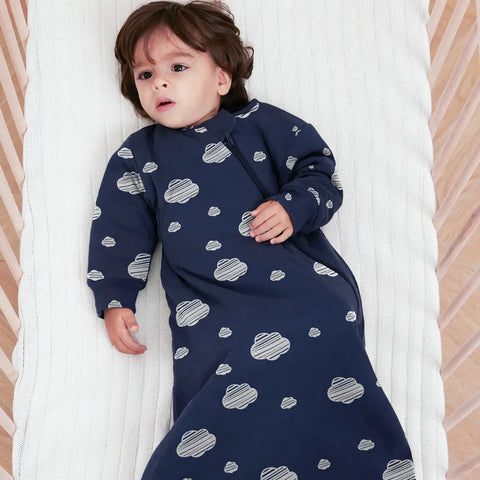
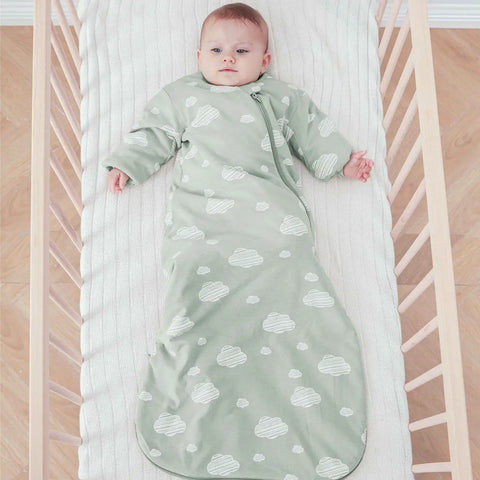
A true swaddle, or any restrictive transitional product that wraps the arms, limits the exact movements a baby needs to reposition themselves safely once they can roll. This is different from a correctly sized, arms-free, non-weighted sleep sack, which allows a baby to move their arms and legs freely.
If your baby has been swaddled and is starting to show signs of rolling or working an arm loose, it's time to transition. Our guide to moving from a swaddle to a sleep sack walks through that switch.
A properly fitted, arms-free, non-weighted sleep sack should leave room for the hips and legs to move freely. It provides wearable warmth without loose bedding, but it cannot prevent every contact with crib rails or every instance of a limb entering the slats.
It is not a substitute for checking that the sleep space itself is safe.
When should crib movement concern you?
Most crib movement, including a lot of it, is a normal part of active infant sleep and developing mobility. It's worth a professional evaluation if movement comes with any of the following:
- breathing difficulty or a change in color
- loss of consciousness
- seizure-like or repetitive movements that can't be interrupted
- repeated vomiting after a noticeable impact
- unusual drowsiness or difficulty waking
- consistent use of only one side of the body
- loss of a motor skill your baby had already gained
- injury, persistent distress, or behavior clearly different from your baby's normal pattern
This list is meant to flag when to check in with your pediatrician, not to diagnose anything on its own.
Conclusion
Start every sleep with your baby wholly on their back, keep the sleep space firm, flat, level, and bare, and follow your crib or bassinet's manufacturer limits.
From there, it's usually fine to leave a baby who has settled safely wherever they've moved to. Respond promptly if you see obstruction, entrapment, injury, distress, or any of the concerning signs above, and check with your pediatrician whenever something looks or feels different from your baby's normal pattern.
Best Sellers





Read more
Which Sleep Position Is Safe For Babies?
In the realm of infant care, ensuring a safe and comfortable sleep environment is paramount. Thanks to safe, sound sleep in a cozy environment, our babies can grow both physically and mentally. He...
Read more
Which sleep position is the best for babies?
Sleep is a vital function for humans. People's brains and bodies can relax and recover from tiredness with sufficient sleep. Most people spend a third of their lives either asleep or resting, espec...
Read more
Leave a comment
This site is protected by hCaptcha and the hCaptcha Privacy Policy and Terms of Service apply.