


Receiving Blanket vs Swaddle: What the Size Charts Say


One is a small cloth you fold. The other is either a much larger cloth or a garment that wraps and fastens. They get shelved together, they arrive at the same baby shower, and they are not interchangeable.
The clearest way to see why is to stop reading product descriptions and read the size charts instead.
What is the difference between a receiving blanket and a swaddle?
We pulled the published dimensions for eight products from six brands' own product and size pages in September 2026. The square receiving blankets measured 28 to 30 inches on a side; the swaddle blankets measured 46 to 47. That is roughly seventeen inches of extra fabric per side, and it is most of the story.
| Product | Brand publishes | Fabric |
| Gerber 5-Pack Flannel Receiving Blankets | 30in x 30in | 100% cotton flannel |
| Hudson Baby Cotton Poly Flannel Receiving Blankets | 28x28 inches | 70% cotton, 30% polyester |
| Burt's Bees Baby Thermal Organic Receiving Blanket | Measures 30" x 30" | organic cotton thermal |
| Burt's Bees Baby Organic Cotton Receiving Blankets 2 Pack | Measures 29" x 29" | organic cotton rib |
| Carter's Baby 2-Pack Waffle Knit Blankets | 40" L x 30" W | waffle knit |
| Little Unicorn Cotton Muslin Swaddle Blanket | 47 in x 47 in | cotton muslin |
| Burt's Bees Baby Muslin Swaddle Blankets | Measures 47" x 47" | organic cotton muslin |
| Kyte Baby Bamboo Swaddle Blanket | 46 inches by 46 inches | bamboo |
Every figure in that table came from the brand's own product or size page, not a retailer listing.
How big is a receiving blanket?
Smaller than the figure at the top of the results page, and not always square. When we ran this exact search in September 2026, Google's AI summary described receiving blankets as "roughly 30 to 36 inches." The square ones we found print 28, 29, and 30, and none of the three brands publishing them reached 36.
Shape is the other thing that summary flattens. Gerber, Hudson Baby and Burt's Bees Baby are all square, while Carter's is 40 by 30, a rectangle that runs longer on one axis than any square receiving blanket in our sample.
So "receiving blanket" names a job, not a dimension. Two products carrying that label can differ by twelve inches on the longer side, which is the gap between Hudson Baby's 28 and Carter's 40.
Burt's Bees Baby makes the point on a single page, publishing a thermal receiving blanket at 30 by 30 and a ribbed cotton pair at 29 by 29. Same brand, same category name, different cloth.
How big is a swaddle blanket?
Tighter agreement here, though not unanimous. Two of the six brands whose own pages we read directly print exactly 47 inches square: Little Unicorn at 47 in x 47 in, and Burt's Bees Baby at 47" x 47". Kyte Baby is the one that differs, at 46 inches by 46 inches.
Nest Designs prints 120 x 120 cm and converts it on the page to 47 x 47 in. We took that one from its regional storefront rather than its US product page, so we hold it a step below the rest.
aden + anais describes the category as a range rather than a figure. Its swaddling guide says swaddles "come in a variety of sizes but most are between 40 and 48 inches square," a bracket that contains every swaddle blanket we measured.
One caution on counting brands here. That aden + anais guide now serves from halosleep.com under the banner "Halo x aden + anais," so the two are one site and we count them once.
Why is there a third size the charts leave out?
A two-column comparison has room for two products, and a lot of parents buy something in neither column. A shaped swaddle is not sized as a square of fabric, and the brands do not even agree on what to measure instead.
The Ollie publishes garment dimensions: 30.5 inches long, 28 inches wide, in a single size. Its FAQ says the swaddle is designed to be used from day one. SwaddleMe by Ingenuity sizes its fit the other way, by the infant rather than by a cloth dimension: 7 to 14 pounds, up to 26 inches long.
Our own ClimaCuddle® Swaddle 2-in-1 takes the second approach. It is sized by height and weight on a size chart, from 21 to 27 inches and 7 to 18 pounds, because it has adjustable sleeves and a neck opening rather than four corners.
This is why "how big is a swaddle" has no single answer. The third kind is not sized like a blanket, and the brands making it do not measure it the same way as each other.
| What it is | How it is sized | Example published figure |
| Receiving blanket | by the cloth | 28-30 inches square, or 40 x 30 |
| Swaddle blanket | by the cloth | 46-47 inches square |
| Shaped swaddle, measured as a garment | by the garment | 30.5 x 28 in (The Ollie) |
| Shaped swaddle, measured by the baby | by height and weight | up to 26 in (SwaddleMe); 21-27 in and 7-18 lb (Kaiya Baby) |
A chart that compares only the first two rows is answering a question about fabric, not about what ends up on the baby.
Can you swaddle a newborn with a receiving blanket?
People do, and brand copy allows it while the size charts show the friction. Pottery Barn Kids frames it as a one-way relationship: a receiving blanket can be used as a swaddle blanket, it says, but not every swaddle blanket is a receiving blanket.
The published sizes explain the friction. A 30-inch square has to reach around the torso, cross over, and still have something left to tuck.
Against that same 30-inch square, a 47-inch one carries roughly two and a half times the area; against the single 28-inch square in our table, closer to three times. That gap is the context for aden + anais's 40-inch lower bound.
Fit is a separate question from sleep-safety guidance. For the constraint that governs the wrap itself, see: can a swaddle be too tight.
What do receiving blankets get used for instead?
Hudson Baby's own product page lists the jobs: blanket, nursing cover, burp cloth, car seat cover, tummy time, changing pad cover. Swaddling does not appear on that list.
Gerber's page covers part of the same ground: warmth, a changing station, a burp cloth. Neither page leads with swaddling.
A receiving blanket is a utility cloth first, and whether it is large enough to wrap a given baby is a separate question its own size listing answers. The multipacks fit that job: spill-prone, swapped often, not worn one at a time.
How many of each do you need?
Different answers, because they are doing different jobs. Receiving blankets ship in multipacks: the Gerber set we measured is a five-pack, and Burt's Bees Baby sells its organic cotton pair in twos.
Swaddles are not. A baby wears one at a time, overnight, and the number you need is set by your laundry cycle rather than by spills.
We worked through that arithmetic for sleep-stage products in how many sleep sacks for the newborn, and the same logic applies to shaped swaddles: multipacks of utility cloth, singles or pairs of the thing they sleep in.
What does the AAP say about loose blankets at night?
It draws a line between sleep clothing and coverings, and both products on this page fall on the coverings side of it. The American Academy of Pediatrics puts it this way: infant sleep clothing, such as a wearable blanket or sleep sack, "is preferred over blankets and other coverings to keep a baby warm."
A receiving blanket is a blanket. So is a swaddle blanket, at a larger size.
That AAP page is worth reading in full rather than summarised, because it also carries the timing rule in the next section.
What changes when the baby starts to roll?
The cloth question ends, and it ends on a cue rather than on a date. The AAP's instruction is direct: "Stop swaddling as soon as your baby shows any signs of trying to roll over."
That is behavioural. It does not wait for the blanket to be outgrown, and it does not arrive on a fixed week.
It is also why a 47-inch swaddle blanket bought before the birth may see a shorter working life than its size suggests. The limit is the baby's motor development, not the fabric.
What follows is a different product category, and we walk through the handover in transitioning from swaddle to sleep sack.
So which should you buy?
Buy receiving blankets as utility cloth, and buy a swaddle for the wrapping stage. They are not substitutes, and the pack sizes tell you that before the labels do.
Receiving blankets at 28 to 30 inches earn their place as burp cloths, covers, and changing surfaces long after they stop being big enough to wrap anyone.
If the goal is the wrap itself, the published sizes point at either a 46-to-47-inch blanket or a shaped swaddle, and the shaped ones remove the folding question entirely.
All of that assumes wrapping is still on the table. If your baby is showing any sign of trying to roll, the AAP's rule above ends the wrapping stage regardless of which cloth you own, and the product that follows is a sleep sack rather than a swaddle.
While you are still in that stage, you can see how we size ours on the swaddle size chart, or look at the baby swaddles we make. If you are already past it, the comparison you want is swaddle vs sleep sack.
Frequently Asked Questions
Is a receiving blanket the same as a swaddle blanket?
No. On the brand pages we read, square receiving blankets measured 28 to 30 inches on a side, and swaddle blankets measured 46 to 47.
The label describes a different job and a different size of cloth.
What size is a standard receiving blanket?
There is no single standard. Gerber publishes 30 in x 30 in, Hudson Baby publishes 28 in x 28 in, and Carter's publishes a rectangular 40" L x 30" W.
All three are sold as receiving blankets.
Do you really need receiving blankets?
They are useful as utility cloths rather than as sleep gear. Hudson Baby lists nursing cover, burp cloth, car seat cover, tummy time, and changing pad cover among the uses on its own product page.
When do you stop using receiving blankets for swaddling?
The AAP's rule is not about size: stop swaddling as soon as your baby shows any signs of trying to roll over. That is a behavioural cue rather than a set age or a set weight.
What is the difference between a muslin blanket and a receiving blanket?
Muslin describes the weave; receiving blanket describes the job. The muslin swaddle blankets we found were 46 to 47 inches square, considerably larger than the flannel receiving blankets at 28 to 30 inches.
How many receiving blankets do you need?
Brands sell them in multipacks. The Gerber set we measured is a five-pack, and Burt's Bees Baby sells its organic cotton receiving blankets in twos.
Can a receiving blanket be used as a swaddle?
Sometimes. Pottery Barn Kids frames it as one-way: a receiving blanket can be used as a swaddle blanket, but not every swaddle blanket is a receiving blanket. The size gap is why.
How big does a swaddle blanket need to be?
Aden + Anais's swaddling guide says swaddles "come in a variety of sizes, but most are between 40 and 48 inches square." Every swaddle blanket we measured fell within that range, at 46 or 47 inches.
Do all brands publish the same receiving blanket size?
No. Burt's Bees Baby lists two sizes in its size guide: a thermal at 30" x 30" and a ribbed pair at 29" x 29".
Across the brands we checked, published figures ran from 28 to 40 inches on the longer side.
What does the AAP say about blankets in the crib?
It states that infant sleep clothing, such as a wearable blanket or sleep sack, is preferred over blankets and other coverings for keeping a baby warm.
A receiving blanket and a swaddle blanket are both blankets.
Best Sellers

Read more
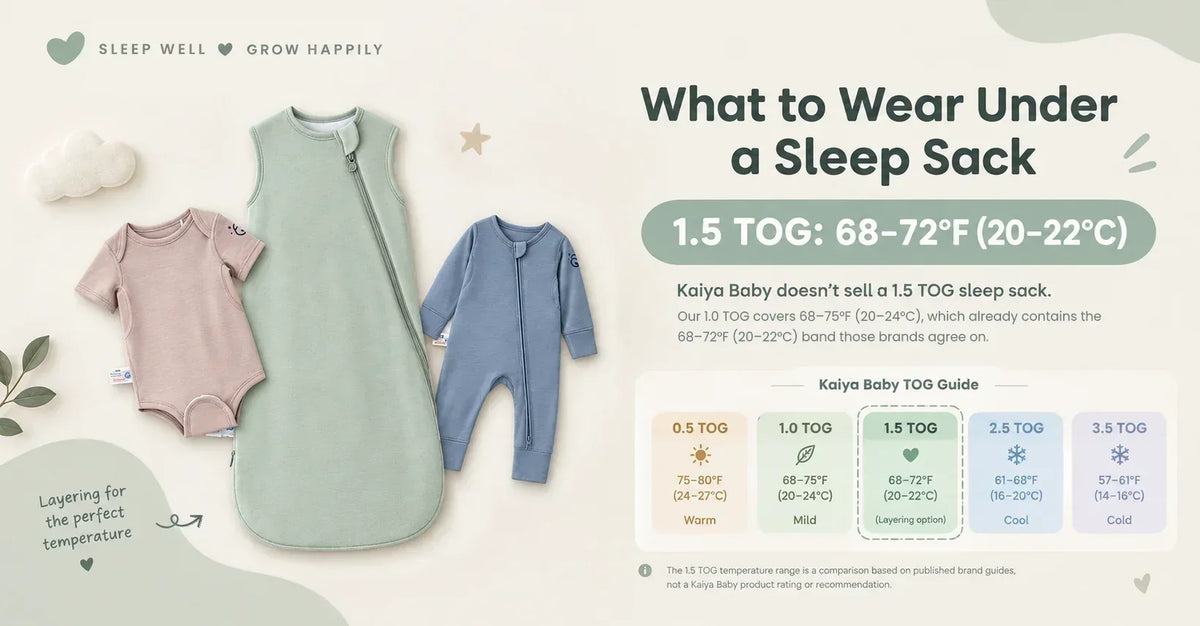
1.5 TOG Sleep Sack Temperature: The Range Brands Agree On
We checked eleven baby sleep sack brands. Five of them publish a room-temperature range in Fahrenheit for a 1.5 TOG, and across those five, the only band they all share is 68–72°F (20–22°C). Outsid...
Read more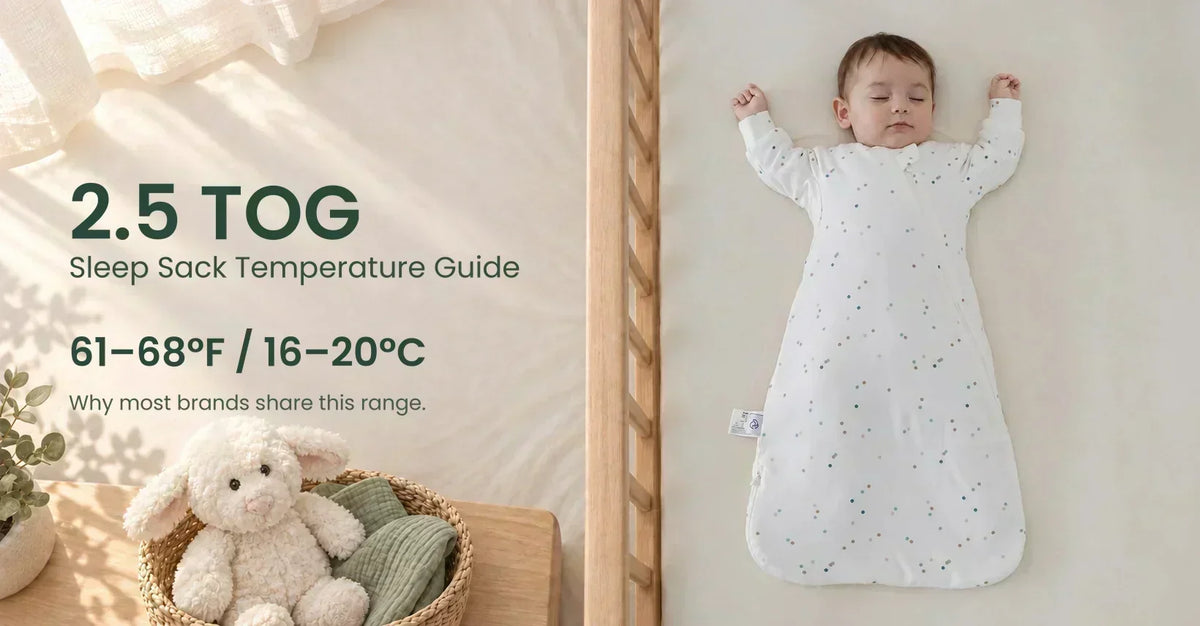
2.5 TOG Temperature Ranges From Sixteen Brands
A 2.5 TOG sleep sack arrives with a room temperature printed on the label—different brands, different labels, so you would expect those numbers to disagree. Most of those numbers do not, and the re...
Read more
Leave a comment
This site is protected by hCaptcha and the hCaptcha Privacy Policy and Terms of Service apply.